The schedule guesses.
ClearPath sees.
On-demand custodial and hauler dispatch for waste and recycling. The route shrinks to the bins that need service.
Calendar-based custodial rounds run blind.
A custodian walks a fixed route at a fixed cadence. Some bins are full, but most aren’t. The route doesn’t change either way.
Calendar-based custodial work is the operational default in waste and recycling. The schedule is a guess at where the work will be.
The guess is mostly wrong. The team services bins that didn’t need it and runs past bins that did.
For the ops director: too much labor on the rounds, too little coverage at peak, too much overtime making up the gap.





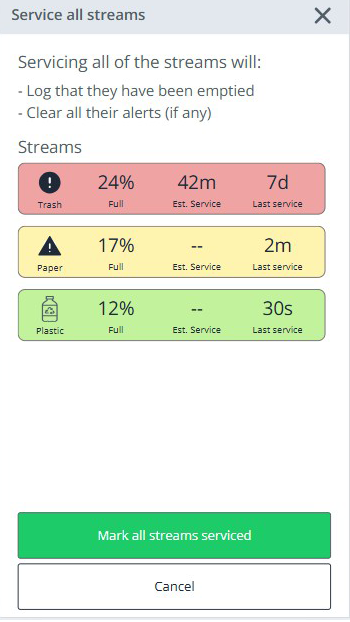
ClearPath sees what’s full and routes the team.
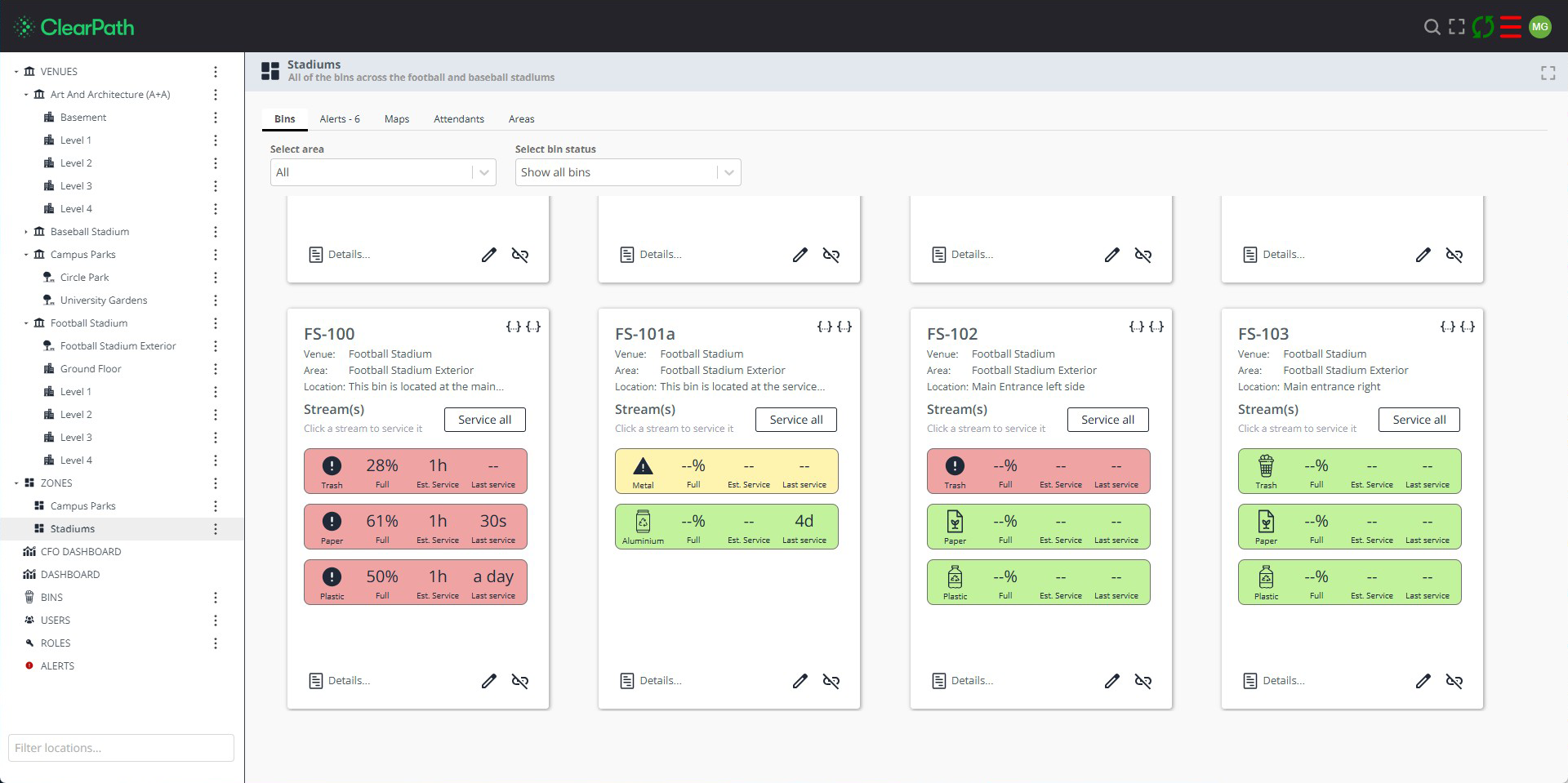
Sensors in every bin track real-time fill. ClearPath reads the data, decides which bins need service, and assembles the route in real time.
The custodian opens a mobile hit list and sees the bins to service in priority order. The supervisor sees the same operation from a facility-wide dashboard. Both see how full each bin is.
For haulers, ClearPath surfaces which dumpsters and compactors need pickup before the schedule says so. Routes get re-sequenced. Pickups happen against actual fill.
Custodians cover more ground without more headcount.
Calendar-based custodial work is labor-intensive by design. Routes are sized for worst-case demand and run at worst-case cadence regardless of actual conditions. The result is a crew running rounds that don’t move the operation forward.
ClearPath turns the calendar work into demand-triggered work. The hours spent on bins that didn’t need attention come back to the crew.
Some operations use those hours to reduce overtime and contract labor. Most use them to cover deeper cleans, deferred projects, and quality work that always slips first under pressure.
A 300-bin, 750-stream university campus running a three-FTE custodial team recovers $28,980 a year in labor efficiency from wasted rounds alone. Another $12,000 to $18,000 comes back in overtime, and contract labor is avoided.
The next FTE hire that growth would have forced (worth around $46,000 fully loaded) doesn’t need to happen. The crew the operation already has grows into the work.
An overflowing bin at the wrong moment is the same problem. The photo goes on Google Maps. The review stays on your listing long after the bin gets emptied.

Wasted trips disappear. Peak coverage holds.
Demand-triggered dispatch is the headline. The labor, route, and operational savings underneath it are real, and they make the deployment math work before the ESG value even enters the conversation.
Routes compress. Labor follows.
Crews stop walking past full bins to service empty ones. Hauler trucks stop arriving at dumpsters that aren't full. Both routes shrink to the work that's actually there.

Peak demand stops breaking the operation.
Move-in weekends, football Saturdays, graduation, conferences. ClearPath sees the demand and dispatches against it. The peak gets covered without an all-hands scramble.

Diversion data builds itself.
Every service event records the stream (trash, recycling, compost) by bin, by location, by day. The split feeds directly into ESG and sustainability reporting without manual tallying.
Two scenarios.
Two scenarios: a waste and recycling partner running ClearPath on its installed base.

A 300-bin, 750-stream university campus, three FTEs on the custodial team. Calendar-based rounds give way to demand-triggered dispatch. The next FTE hire that growth would force doesn’t need to happen. The crew already in place grows into the work.
A 200-bin, 400-stream event venue running 76 events a year. Per-event staffing runs one fewer. Overtime avoidance reaches $2,760 a year. The peak nights that used to break the schedule hold without crisis dispatching.

In both scenarios, the partner keeps the customer relationship, brands ClearPath as their own service, and adds recurring subscription revenue against equipment that had previously sold once.

Your installed base keeps earning.
Container manufacturers, large haulers, and waste consultancies are the natural ClearPath partners in waste and recycling. The equipment is already in the field. The customer relationship is already there. ClearPath adds the dispatch intelligence and the recurring subscription model on top.
For a partner with thousands or hundreds of thousands of bins in the field, the shift is direct: existing customers add a recurring service tier against bins they already own. The partner brands ClearPath as their own service, keeps the customer relationship, and captures the recurring revenue. ObjectSpectrum builds and operates the platform.