Event day holds together. The sweep doesn't have to.
On-demand restocking for event venues and golf courses. Fan-facing dispensers, concession supplies, sand bottles, ball washers, and divot mix. Service goes to the points that need it, when they need it, before the guest notices.
Calendar-based cart sweeps fail at the moments guests notice.
A golf course employee drives the cart paths every two hours, checking sand bottles and ball washers across 18 holes. A stadium ops crew walks the concourse on a fixed loop during events, checking fan-facing dispensers and concession supplies. The schedule is a guess at where the work will be.
The guess is mostly wrong. Half the service points are still fine. A few are already out, and have been for the last hour. The cart or the crew moves through the operation regardless. The depletion doesn’t follow the schedule.
The cost shows up in two places, both of which carry more weight than the labor on the round itself. On event days, demand spikes faster than a fixed-cadence sweep can cover. Concession-area dispensers run dry during halftime. Fan-facing supplies fail at moments thousands of people are paying attention. On golf courses, a missing sand bottle on the 14th tee during a member-guest tournament becomes a complaint to the GM that lands in the next week’s board recap. The visibility of the failure makes the calendar gap operationally and reputationally expensive.
For the ops director: every event and every tournament is a coin flip on whether the schedule covers the load. The schedule was sized for average. The peak is what guests remember.





ClearPath sees the depletion and routes the team before guests notice.
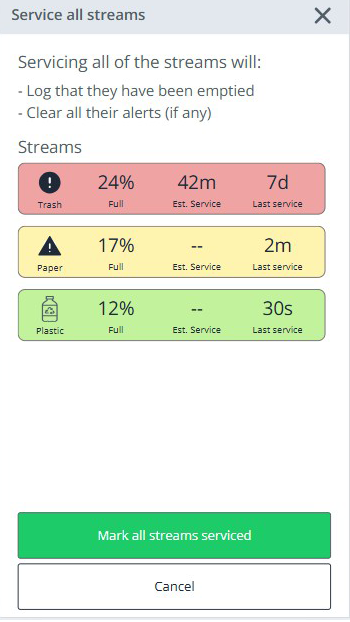
Sensors at every service point track real-time depletion. ClearPath reads the data, decides which points need restocking, and assembles the route in real time.
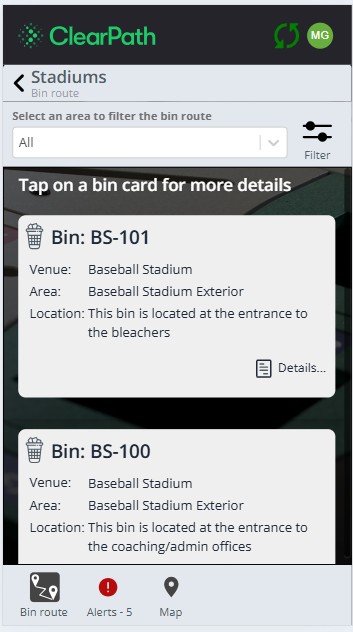
The service tech opens a mobile hit list and sees the points to service in priority order, with location and stream visible per row. The supervisor or ops director sees the same operation from a facility-wide dashboard: every sand bottle, every ball washer, every concession-area dispenser, every fan-facing supply point, with depletion status visible across the operation.
The cart sweep stops being the work. The cart becomes the response to what the platform already knows.
The guest sees the supply, not the gap.
In stadium and venue operations, the dominant value isn’t labor reallocation. It’s peak demand coverage, reframed as guest and member experience.
Calendar-based service at a venue or course is brittle under load by design. The cadence is set for average demand, not for the moments when a sold-out event or a Saturday-morning tournament breaks the average. The points that fail during peak are the points that guests are most likely to encounter. A concession-area dispenser empty during halftime. A ball washer dry on the 9th tee with a foursome waiting. A fan-facing supply gap visible to thousands of people simultaneously.
The cost of those moments isn’t labor savings missed. It’s the next-day complaint to the GM, the post-event recap that names the failure, the survey score that drops, the member who didn’t renew. Service failures during peak demand at a guest-facing operation carry costs that don’t show up on a labor line and aren’t recovered by overtime.
ClearPath dispatches against actual demand. The peak gets covered without staffing the baseline for the peak. The supply is there at the moment the guest arrives. The experience holds.
An empty concession dispenser at halftime is a photo taken by someone in a crowd of 50,000 people with phones. It's on Google Maps by the third quarter. The review stays there the next time someone books your venue or decides whether to renew their membership.

Three ways the math compounds underneath peak coverage.
Peak coverage is the headline. The labor and operational savings underneath it are real, and they make the deployment math work between event days, not just on them.
Cart sweeps shrink. The crew covers more ground.
Calendar-based sweeps touch points that don’t need attention and miss points that do. Demand-triggered dispatch ends both failures. The hours come back to the team.

Event-day staffing stops scaling against the worst case.
Event-day overtime is what most venues spend to absorb peak demand the schedule couldn’t handle. ClearPath dispatches against real-time depletion, so peak coverage comes from smarter routing rather than more bodies on shift.
Inventory pulls become predictable.
Real-time depletion data feeds inventory and procurement. Pulls happen against actual consumption patterns rather than estimated par levels. Less overstock, fewer stockouts, cleaner planning across the calendar.
Two scenarios.
Two illustrative scenarios across the operational profiles where the platform pattern applies.

The golf course or country club
An 18-hole course with sand bottles and ball washers at every tee box, plus practice facility supplies and clubhouse-area dispensers. A two-hour cart-path sweep is the operational default, sized to average play and stretched thin during tournaments and weekend peaks. A missing sand bottle during a member-guest event becomes a member complaint that lands at the board meeting. ClearPath turns the cart sweeps into demand-triggered restocking. The course employee already on staff covers more of the property without growing the crew. The tournament weekends and high-play days stop breaking the operation because the operation isn’t scheduled against them anymore.
The event-driven venue
A stadium, arena, or convention center running 70+ events a year. Each event day is its own load profile, with concession-area dispensers and fan-facing supplies going from fully stocked at gates open to depleted at peak to recovered between sessions. Calendar-based service can’t cover that curve. ClearPath dispatches against actual depletion across thousands of fans, hundreds of service points, and a service window that doesn’t pause. The event holds together at the moments guests are most likely to notice.

Put ClearPath in your event-day workflow.
Tell us about the operation: service-point count, basic geography, the event or play calendar that drives your peak demand. We’ll connect you with the right path to deploy, whether through a regional partner or directly with the team that built ClearPath.
Make your supplies a recurring service business.
Sand bottle suppliers, ball washer manufacturers, divot mix distributors, venue consumables operators, and concession-area supply distributors are the natural ClearPath partners in this category. The equipment is already on the property. The customer relationship is already there. ClearPath adds the dispatch intelligence and the recurring subscription model on top.
The stadium and venue consumables category is open for partner. For a partner with thousands of supply points across venues and courses, the shift is direct: existing customers add a recurring service tier against equipment they already own. The partner brands ClearPath as their own service, keeps the customer relationship, and captures the recurring revenue. ObjectSpectrum builds and operates the platform.